
What is Internationalisation of the Rupee?
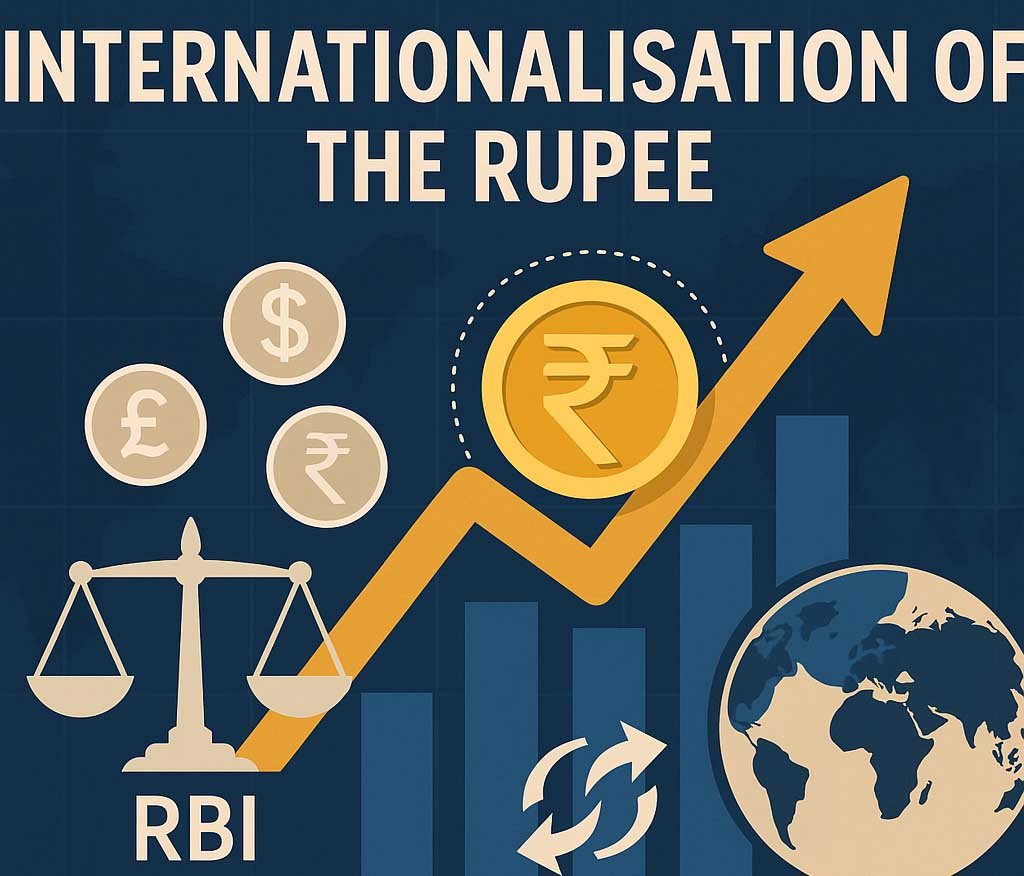
The term Internationalisation of the Rupee refers to expanding the Indian Rupee’s role in global trade and finance, allowing it to be used for cross-border payments, investments, and foreign reserves by other nations.
In simpler words, it means the Indian Rupee becoming as globally accepted as currencies like the US Dollar, Euro, or Pound Sterling.
This vision — long considered ambitious — is now actively pursued by the Reserve Bank of India (RBI) and the Government of India as part of the 2025 economic roadmap.
Why India is Pushing for Rupee Internationalisation
India’s economy has emerged as one of the world’s fastest-growing, and with a GDP nearing USD 4 trillion, the country is now ready to give the Indian Rupee global significance.
Key Reasons:
- Reduce dependence on the United States Dollar to Indian Rupee exchange fluctuations.
- Promote trade settlements in Indian Rupees instead of USD or Euro.
- Strengthen India’s financial autonomy against external shocks.
- Attract foreign investment into Indian assets without relying entirely on foreign currencies.
Just as China internationalised the Yuan (Renminbi), India’s step marks a milestone in achieving monetary sovereignty.
Table of Contents

The RBI’s 2025 Strategy for a Global Indian Rupee
In 2025, the Reserve Bank of India (RBI) announced a structured plan for the Internationalisation of the Rupee:
- Rupee Trade Accounts: Partner countries can maintain INR Vostro Accounts for trade settlements.
- Currency Swap Agreements: To reduce volatility against major pairs like USD to Indian Rupee, Pound to Indian Rupee, and Riyal to Indian Rupees.
- Digital Rupee Expansion: RBI’s Central Bank Digital Currency (CBDC) will facilitate faster international payments.
- Bilateral Trade Agreements: With countries in Asia, Africa, and the Middle East to promote direct Rupee trade.
This multi-step roadmap aims to transform the Indian Rupee from a regional trade currency to a recognized international unit.
Benefits of Internationalisation of the Rupee
1. Reduced Dollar Dependency
Currently, over 80% of India’s imports and exports are invoiced in USD. Once the Internationalisation of the Rupee gains traction, fewer payments will need conversion between USD to Indian Rupee, reducing costs and volatility.

2. Strengthened Economic Stability
The move shields India from global currency shocks. If the Dollar in Indian Rupees rises sharply, exporters and importers still benefit from stable INR-based trade.
3. Enhanced Global Confidence
As more countries hold Indian Rupee reserves, India’s global financial influence strengthens — similar to how the Pound Sterling once dominated global finance.
4. Boost to Domestic Markets
Increased INR demand stabilizes exchange rates like:
- 1 United States Dollar to Indian Rupee ≈ ₹83.10
- 1 Pound to Indian Rupee ≈ ₹105.80
- 1 Riyal to Indian Rupees ≈ ₹22.20
When these pairs stabilize, investor confidence grows in both equity and bond markets.
Challenges in Making the Rupee a Global Currency
The Internationalisation of the Rupee faces practical and policy challenges:
- Capital Account Restrictions: India still controls the inflow/outflow of foreign money.
- Trade Deficit: Imports exceed exports, limiting demand for INR abroad.
- Volatility Risks: Sudden fluctuations between Indian Rupee to Dollar can deter foreign investors.
- Infrastructure Gaps: Limited international banking partnerships for INR settlements.
Experts note that while full convertibility is years away, gradual liberalisation is the right path forward.
You may also like:
Global Context – USD, Pound, Riyal, and Dollar Exchange Insights
The dominance of the US Dollar remains unparalleled, but cracks are forming in the global financial order.
- USD to Indian Rupee rates continue to reflect macro-economic power differences.
- United States Dollar to Indian Rupee has appreciated over the last decade, but India’s export base is catching up.
- Pound to Indian Rupee shows volatility with UK inflation, yet INR remains relatively steady.
- Riyal to Indian Rupees matters for millions of Indian expatriates remitting money home.
Countries like Saudi Arabia, Russia, and Sri Lanka have already begun settling partial trade in Rupees, a milestone in the Internationalisation of the Rupee.
How Trade Partners Are Adapting
Many of India’s partners in Asia, Africa, and the Middle East now prefer Rupee settlements to avoid Dollar transaction costs.
Example:
- Bangladesh, Nepal, and Mauritius have opened INR-based accounts for bilateral trade.
- UAE and Saudi Arabia are exploring energy trade in Rupees, potentially reducing pressure on Riyal to Indian Rupees conversions.
- Russia now conducts a significant share of oil trade with India using INR instead of USD.
This indicates growing global trust in India’s economic fundamentals.

Impact on Exporters and Importers
The Internationalisation of the Rupee benefits businesses directly.
Exporters:
- Receive payments in INR, saving conversion losses between Indian Rupees to USD.
- Gain better predictability in revenue and pricing.
Importers:
- Avoid exposure to high 100 Dollar in Indian Rupees exchange costs.
- Can hedge risks in INR, improving cash-flow stability.
Banks and Investors:
- INR-linked products like sovereign green bonds and trade-credit lines will attract more foreign participation.
The Future of the Indian Rupee – Global Comparisons and Projections
Experts predict that by 2030, the Indian Rupee could emerge as a regional reserve currency, alongside the Chinese Yuan and Japanese Yen.
If India maintains fiscal discipline and inflation control, Internationalisation of the Rupee will:
- Reduce pressure on foreign exchange reserves.
- Encourage Indian Rupee to USD convertibility.
- Position India as a global financial hub, particularly through Mumbai International Financial Services Centre (IFSC).
Just as the Amazon share price and Apple share price reflect the strength of US markets, the Rupee’s global usage will represent India’s growing influence.
frequently asked questions
It refers to expanding the Indian Rupee’s role in international trade and finance, allowing it to be used globally for payments and reserves.
As global Rupee use increases, demand for INR rises, leading to greater stability and possibly a stronger Rupee against the USD.
RBI introduced INR trade settlement accounts, currency swaps, and digital Rupee frameworks to support cross-border INR use.
Not immediately. The Dollar in Indian Rupees still dominates global trade, but the Rupee is steadily increasing its influence regionally.
A globally accepted Rupee could make travel, remittances, and imports cheaper — especially for those converting Indian Rupee to USD or Indian Rupees to other currencies.
Final Thoughts
The Internationalisation of the Rupee is more than a monetary reform — it’s a symbol of India’s economic rise.
With the RBI’s policies, digital currency integration, and expanding trade networks, the Indian Rupee is gradually stepping onto the global stage.
As the USD to Indian Rupee, Pound to Indian Rupee, and Riyal to Indian Rupees pairs stabilize, India’s dream of a powerful, globally respected currency looks closer than ever.
This journey marks not just financial evolution, but a step toward true economic independence.